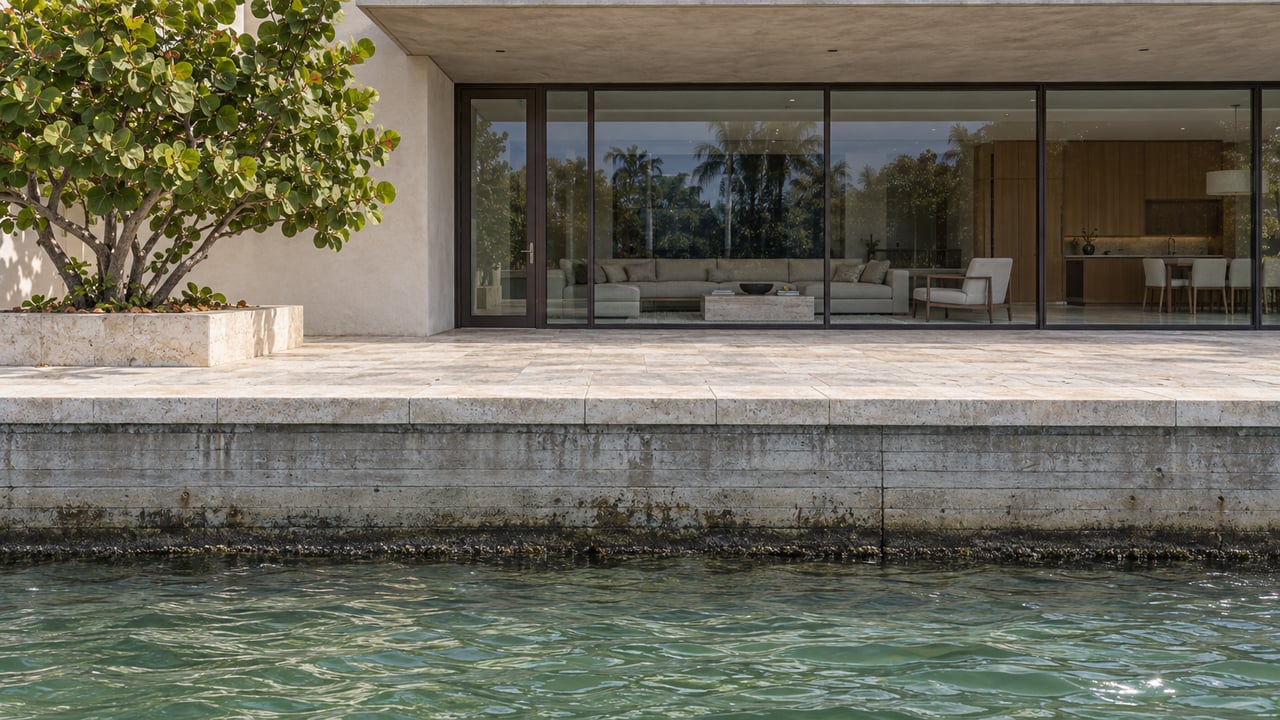
Drive along N. Bayshore Drive between NE 94th and NE 96th Street and you will hit a chain-link fence where the walking path used to be. The gate has been padlocked since construction started in 2024, and the 900 feet of shoreline behind it, the same stretch where people used to watch the sun come up over Biscayne Bay before work, has been off-limits ever since. Miami Shores Village says on its own project page that the closure will last for the duration of construction, with completion expected this winter.
What's easy to miss from the road is that this isn't a routine seawall patch job. The Village hired Kind Designs to install what the company describes on its own project page as the first 3D-printed Living Seawall built at a public park anywhere. When the fence comes down, Bayfront Park will have a shoreline doing something no other bayfront park nearby is doing yet.
Why The Old Wall Had To Go
The problem with the old seawall was straightforward. It sat low, and after decades of exposure it had deteriorated to the point where high tides and storm surge could overtop it directly. According to the Village's fact sheet, saltwater spilling over the wall discolored the walking path, threatened the health of the grass, and pushed saltwater into the Village's stormwater drains. During the rainy season, the flooding was severe enough to make the park inaccessible to visitors, which is the same complaint anyone who has tried to time a walk around a summer thunderstorm here already knows firsthand.
That kind of failure is common along aging South Florida seawalls, and the usual fix is to pour a taller concrete wall in the same footprint and move on. Miami Shores went a different direction.
A Living Seawall, Not Just A Taller One
The Village's plan, developed with engineering firm Chen Moore and Associates, called for a new, higher wall built in front of the existing one rather than replacing it outright. The old wall stays in place. The new one goes up beside it, raising the elevation enough to handle the tides and storm surge that used to spill over.
The part that makes this project different from a standard bulkhead job is what the new wall is made of. Kind Designs' panels are engineered to support marine life, functioning as habitat for oysters, fish, and other bay species while still doing the structural job of holding back the water. Per the Village's own description, the project includes:
- A raised seawall built in front of the existing structure, which remains in place
- Living seawall panels designed to support marine habitat along the new bulkhead
- Restoration of the park's green space and walking path, disturbed during construction
- A completion target of winter 2026, per the Village's public project page
The design phase alone carried a budget of $366,670, funded through a matching grant structure with the Florida Inland Navigation District and the Florida Department of Environmental Protection. That's before construction costs, which speaks to how much engineering went into a stretch of shoreline that most people only ever experienced as a place to walk the dog or watch the water.
The Fine Print That Keeps It Public
One detail in the grant paperwork is worth knowing if you've ever wondered whether a project like this quietly turns a public park into something more restricted. The FIND grant that helped fund the seawall specifically requires that waterfront access be provided to all visitors once the work is done. That condition isn't a promise from the Village council, it's a term attached to the money itself, which means the finished shoreline has to stay open to the public as a condition of the funding that built it.
Design phase: February 2023 to May 2024. Construction start: June 2024. Expected completion: winter 2026, per Miami Shores Village's project page.
If that schedule held, the park will have been closed for roughly two and a half years by the time the fence comes down, longer than the Village's original construction estimate suggested when the project was first announced.
What Didn't Close
Losing a 900-foot stretch of waterfront for that long is a real gap, but it's a gap in a system that kept running everywhere else. Miami Shores Village lists an Aquatic Center, Athletic Fields, the C. Lawton McCall Community Center, a Dog Park, a Tennis Center, and Tot Lot Park among its other recreation facilities, and the parks and recreation department has said it runs more than 40 classes a week across youth, adult, senior, and after-school programming. The bayfront loop was one piece of that system, not the whole thing, and the rest of it never paused for construction.
The neighborhood's other long-running anchor kept running too. Miami Shores Country Club opened in 1939, designed by golf architects Robert "Red" Lawrence and Louis Wilson, and its 18-hole, par-71 course has hosted the Florida State Open along with rounds by Bob Hope, Joe DiMaggio, Arnold Palmer, Sam Snead, and Lee Trevino over the decades. None of that history depended on the bay side of the Village, and none of it slowed down while the seawall project moved through design, permitting, and construction.
The Two Blocks That Didn't Wait
A few blocks inland from the closed shoreline, on NE 98th Street, a different kind of local story was unfolding on its own timeline. Deborah Shrem took over a small storefront that had been home to Paradise Beach Gelato, ran it as a trial through the spring of 2025, and opened it that November as Meli, a sugar-free Greek frozen yogurt shop sweetened with allulose instead of cane sugar. The shop went viral almost immediately, with lines out the door and a spot on a national Time Out roundup of top froyo destinations.
Ten months later, Meli had outgrown its original address. By early September 2026, the brand had opened a second location in the South Miami and South Gables area at 6601 South Red Road, a bigger storefront than the original but built around the same tart yogurt and the same rotating toppings. The original 210 NE 98th Street shop is still the smaller of the two, still run out of the same tiny space, and still the one people mean when they talk about where Meli started.
Two very different timelines are running through Miami Shores right now. One is a multi-year infrastructure project that has kept 900 feet of shoreline fenced off since 2024, with a public reopening now expected sometime this winter. The other is a single storefront that went from a spring trial run to a second location outside the Village in under a year. Both are evidence of the same thing: a neighborhood where the bayfront is being rebuilt to last, and the two blocks around it never stopped moving in the meantime.
When that gate finally comes off its padlock, the walk along N. Bayshore Drive will look almost the same as it always did. What's underneath it won't be.
If you've been watching the seawall project from your own stretch of Miami Shores and you're curious what a shoreline investment like this means for property values along the bay, Nancy Batchelor Team has spent 25 years tracking exactly this kind of change across Biscayne Bay's waterfront neighborhoods. Let's connect.